Card Clash for Business
Your product range is already a deck.
Every company sits on comparable numbers — tariffs, specifications, lead times, fees, energy use, emissions. Card Clash turns them into something a customer chooses to spend two minutes with, and remembers afterwards. The same engine schools use to teach magnitudes, pointed at your portfolio.
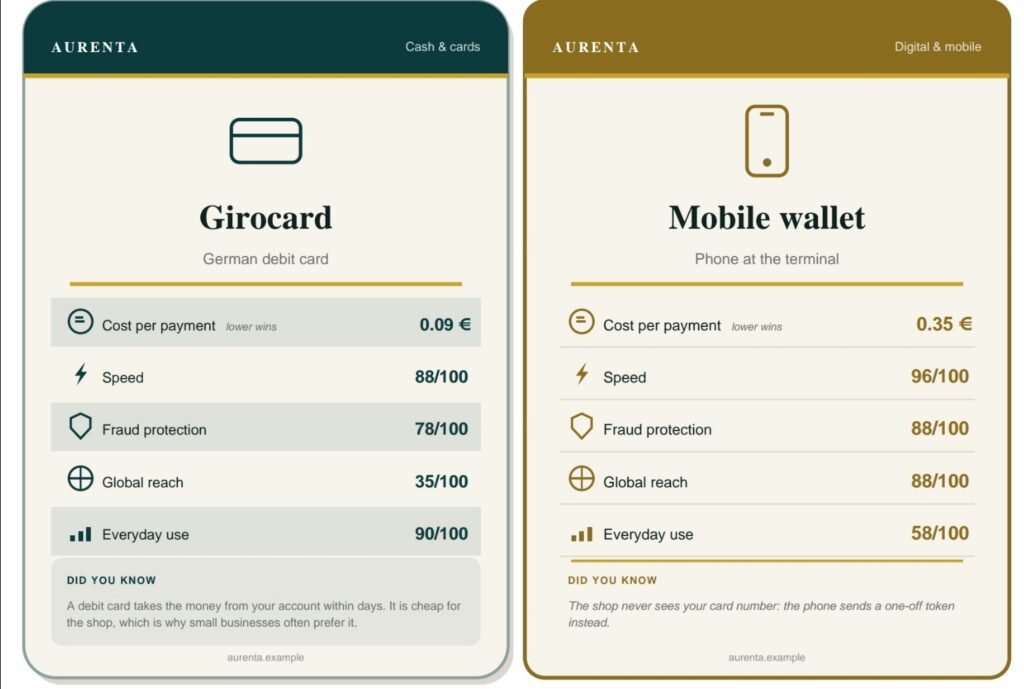
It points two ways.
Outward at the people you want as customers, and inward at the people who have to explain what you sell.
Outward · Customers
Teach them something true about your market
How the tariffs actually differ. What the specification means in practice. Which figure is the one worth caring about. Marketing that earns its attention by being useful — and lands your range in the process.
Inward · Your people
Get new starters fluent in the range
A new colleague can read the catalogue and retain almost none of it. Playing the catalogue is faster, and it produces a score, a completion and a report on which products they keep getting wrong.
Why use this
Six reasons a deck beats another leaflet.
A channel you don’t have yet
Your portfolio has a brochure, a spec sheet and a product page. None of them is something a customer voluntarily spends two minutes with. A deck is.
It survives the scroll
A feed is a queue of things asking for one second each. A round of Card Clash asks for a decision instead of a glance — and a decision is what stops the thumb.
Minutes, not a glance
Engagement that goes past the cover of a leaflet, and happens somewhere you control rather than inside a third party’s app, under their rules and their analytics.
Familiarity, then recall
Players meet the same attributes round after round. That repetition is what turns a range from a list of names into a shape somebody can recall — yours, and where it sits against the alternatives.
Worth passing on
Nobody forwards a spec sheet. People do hand a deck across a table, challenge a colleague and play again. If it is genuinely fun and genuinely informative, the reach is the part you don’t pay for.
Standing, not just noise
A deck that teaches something real puts you in the position of a good-faith source rather than another advertiser. That association is durable — and it is only available to companies whose numbers hold up.
From a card to a customer
The deck is the top of the funnel, not the end of it.
A game that goes nowhere is a nice gesture. Every route into the deck needs a route out of it — onto your site, at the moment somebody is actually curious.
-
Reach
A social campaign, or a printed deck handed out where your audience already is — a trade fair, a branch, a conference, a school visit.
-
Play
They play a round, on a phone or across a table. Two minutes with your figures, instead of two seconds with your leaflet.
-
Step across
A QR code on the card back, or a link under the game, moves them from playing to your site without breaking the moment.
-
Convert
Onto the product page, the shop or the contact form — with your numbers already in their head.
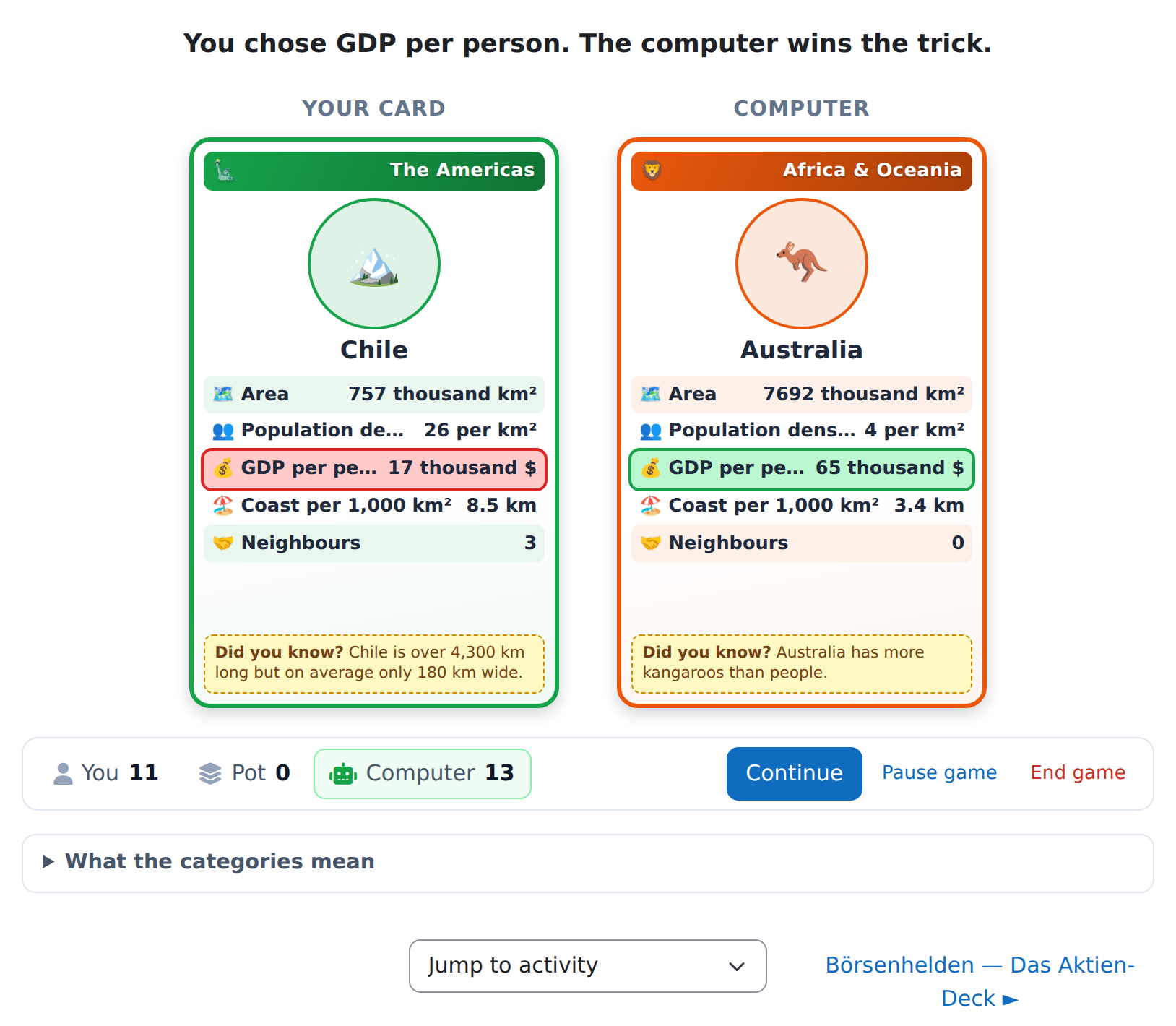
The printed deck is the interesting half. A branded physical deck about your own products is a giveaway people play on the train home rather than drop in the bin at the exit — and every card back can carry a QR code straight to the thing it describes. Printed decks · see a worked example
Where the deck comes from
Two places your deck is hiding.
The data you already have
Price, throughput, warranty term, energy use, lead time, coverage, fee, footprint. If it lives in a spreadsheet or a spec sheet, it is a column. One row per product, one column per attribute — most companies find their first deck in the product catalogue in an afternoon.
Import it as CSV, check the preview, done. Mark price, emissions or lead time as lower wins and they behave correctly.
The knowledge nobody wrote down
The harder half, and the more valuable one. Your experienced people know which product suits which case, which figure actually decides a sale, and where customers reliably misunderstand you. None of that is in the catalogue.
Building a deck is a way to get it out. Deciding which five numbers belong on a card, and arguing about how to score them, is knowledge capture that happens to produce a usable artefact at the end.
Both are what our deck & didactics support is for — including the workshop format where the argument is the point.
One warning
The honest deck is the effective one.
The temptation with a branded deck is to make your own cards win. Don’t. A deck where the sponsor’s product beats everything on every attribute is a deck people play once, see through immediately, and never trust again — and the good-faith standing described above evaporates with it.
It is also a worse game. If one card wins everything, whoever draws the others can do nothing with them: no choice, no bluff, no reason to play a second round. We measure that before a deck ships, and we would measure it on yours.
Every attribute in our own decks carries a documented source, and we publish the measurements for the decks that fail our own thresholds. That discipline applies to a customer deck for a commercial reason as much as a principled one: a customer who can check one of your numbers is a customer who believes the next one.
Let the competition win sometimes. A deck where somebody else’s card takes the round on price, and yours takes it on lifetime cost, teaches the comparison you actually want made — and it is the only version anybody believes.
Inside the company
Onboarding that produces evidence.
A new starter in sales, service or support has to learn a range they have never touched. Reading it does not work; most of it is gone by Friday. Playing it works, because comparing two products fifty times is what builds the instinct the job actually needs.
Run inside your Moodle, it is a normal activity: scored out of 100, pushed to the gradebook, gated on completion. The knowledge-gap report then shows which attributes people keep choosing and losing — which is a direct map of what your onboarding material is failing to explain.
- Product and tariff comparison
- Regulatory and compliance figures
- Service-level and support tiers
- Sustainability and ESG numbers
- Competitor landscape, honestly scored
- Anything with entities and comparable values
Next step
Send us your product data and your brand guide.
Tell us who you want to reach and what you want them to remember. We’ll tell you honestly whether there is a good deck in your catalogue — and which attributes would make it worth playing twice.